


Step into a new era of development where your terminal becomes an intelligent partner, not just a command-line interface. Imagine a tool that anticipates your needs, crafts code, and pinpoints errors with remarkable precision, all powered by cutting-edge AI. This isn’t a glimpse into the distant future; it’s the reality offered by the Cursor CLI, designed to seamlessly integrate advanced intelligence directly into your daily workflow.
Transform tedious manual tasks into effortless commands and unlock unprecedented levels of efficiency. Developers globally are already leveraging this innovative approach to coding, accelerating their projects and refining their craft. Discover how you can redefine your interaction with code and experience a command line that truly works with you.
- What is Cursor CLI? An Introduction to AI in Your Terminal
- Why Developers are Embracing Cursor CLI for Productivity
- Seamless Installation Guide for Cursor CLI
- System Requirements for Cursor CLI
- Step-by-Step Setup Instructions
- Your First Steps: Basic Commands with Cursor CLI
- Advanced AI Features of the Cursor CLI
- Generating Code with Cursor CLI: A Deep Dive
- Efficient Debugging and Error Fixing Using Cursor CLI
- Customizing Your Cursor CLI Experience
- Integrating Cursor CLI with Your Existing Development Environment
- Practical Use Cases for Cursor CLI in Daily Development
- Boosting Performance: How Cursor CLI Optimizes Your Workflow
- Security Best Practices for AI-Powered CLI Tools
- Cursor CLI vs. Traditional CLI: A Comparative Analysis
- Troubleshooting and FAQs for Cursor CLI Users
- Common Troubleshooting Tips:
- Frequently Asked Questions:
- The Evolution of Command Line Interfaces with Cursor CLI
- Frequently Asked Questions
What is Cursor CLI? An Introduction to AI in Your Terminal
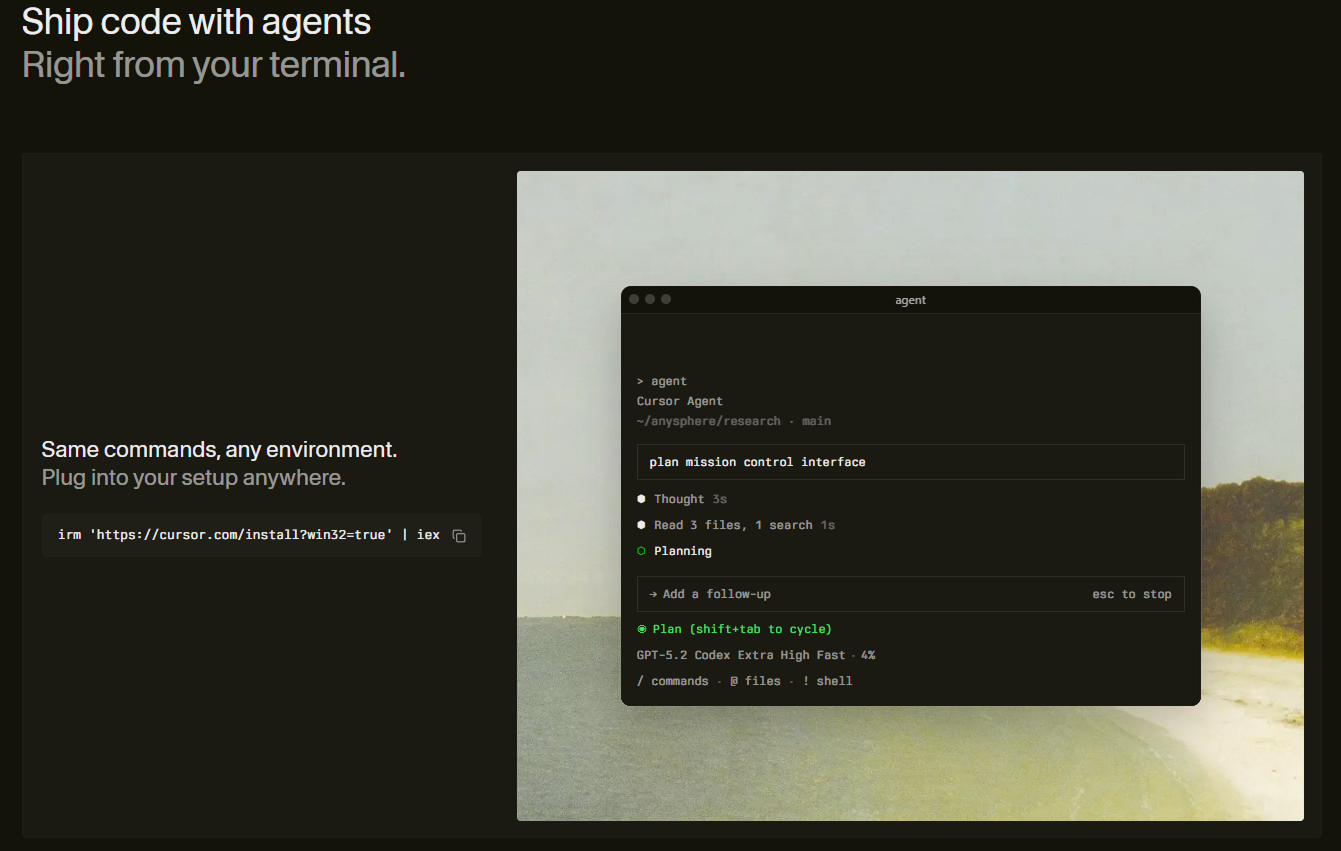
The Cursor CLI is a groundbreaking command line interface that brings sophisticated artificial intelligence directly into your terminal environment. Think of it as your intelligent coding assistant, ready to interpret your intentions and execute complex tasks. It goes far beyond simple auto-completion.
The Cursor CLI makes your daily developer utilities smarter, faster, and more effective, right where you work.
This powerful terminal tool leverages large language models to understand context, generate code, suggest improvements, and even debug your scripting efforts. It seamlessly integrates AI capabilities, transforming a traditionally text-based interface into a dynamic, interactive, and highly intuitive workspace. The Cursor CLI makes your daily developer utilities smarter, faster, and more effective, right where you work.
Why Developers are Embracing Cursor CLI for Productivity
Developers worldwide are quickly adopting the Cursor CLI for one core reason: unmatched productivity. This intelligent terminal tool eliminates significant friction points in the development process, allowing you to focus on innovation rather than repetitive tasks.
Here’s how Cursor CLI supercharges your output:
- Rapid Code Generation: Instantly generate boilerplates, functions, or complex algorithms with simple prompts.
- Contextual Awareness: It understands your project’s structure and existing code, providing hyper-relevant suggestions.
- Error Prevention: Proactively highlights potential issues before you even run your code, saving precious debugging time.
- Reduced Context Switching: Complete more tasks without leaving your command line interface, streamlining your workflow.
- Automated Scripting: Turn intricate scripting challenges into simple conversational prompts, accelerating task completion.
Embrace the future of developer utilities. With Cursor CLI, you don’t just write code; you orchestrate it with AI precision.
Seamless Installation Guide for Cursor CLI
Getting started with the Cursor CLI is straightforward and designed for developers. We aim for a smooth transition, allowing you to quickly integrate this powerful terminal tool into your daily workflow. Follow our clear instructions to unleash the power of AI in your command line interface in no time.
System Requirements for Cursor CLI
Before you dive into the incredible capabilities of the Cursor CLI, ensure your system meets these basic requirements. A little preparation guarantees a smooth installation and optimal performance.
- Operating System: Compatible with major operating systems like macOS, Linux, and Windows Subsystem for Linux (WSL).
- Memory: We recommend at least 8GB of RAM for the best experience, especially when dealing with larger codebases or complex AI queries.
- Disk Space: A minimum of 500MB free disk space is advisable for the core installation and any temporary files.
- Internet Connection: Essential for initial setup, AI model updates, and leveraging the full capabilities of the AI-powered command line interface.
- Python: A recent version of Python (3.8+) is often a prerequisite for many developer utilities; ensure it’s installed and accessible.
Meeting these simple conditions ensures you can fully harness the potential of Cursor CLI as a leading terminal tool.
Step-by-Step Setup Instructions
Ready to transform your command line interface? Follow these easy steps to get your Cursor CLI up and running. You’ll be leveraging AI-powered developer utilities in minutes.
- Download the Installer: Visit the official Cursor CLI download page and select the appropriate package for your operating system.
- Run the Installation Script: Open your terminal tool. Navigate to the downloaded file and execute the installation command. This often involves a simple `curl` command or running an executable script.
- Follow On-Screen Prompts: The installer guides you through necessary permissions and configurations. Grant access as requested.
- Authenticate (if required): For certain features, you might need to authenticate with your Cursor account. This securely links your terminal tool to its powerful AI backend.
- Verify Installation: After installation completes, type `cursor –version` in your terminal. This confirms Cursor CLI is correctly installed and ready for action.
You’re now equipped with an advanced terminal tool. Begin exploring the possibilities of AI-driven scripting and coding with Cursor CLI!
Your First Steps: Basic Commands with Cursor CLI
Welcome to the world of AI-powered developer utilities! Getting started with Cursor CLI is intuitive. These basic commands provide a solid foundation for interacting with your new intelligent terminal tool. Master them to unlock a more efficient command line interface experience.
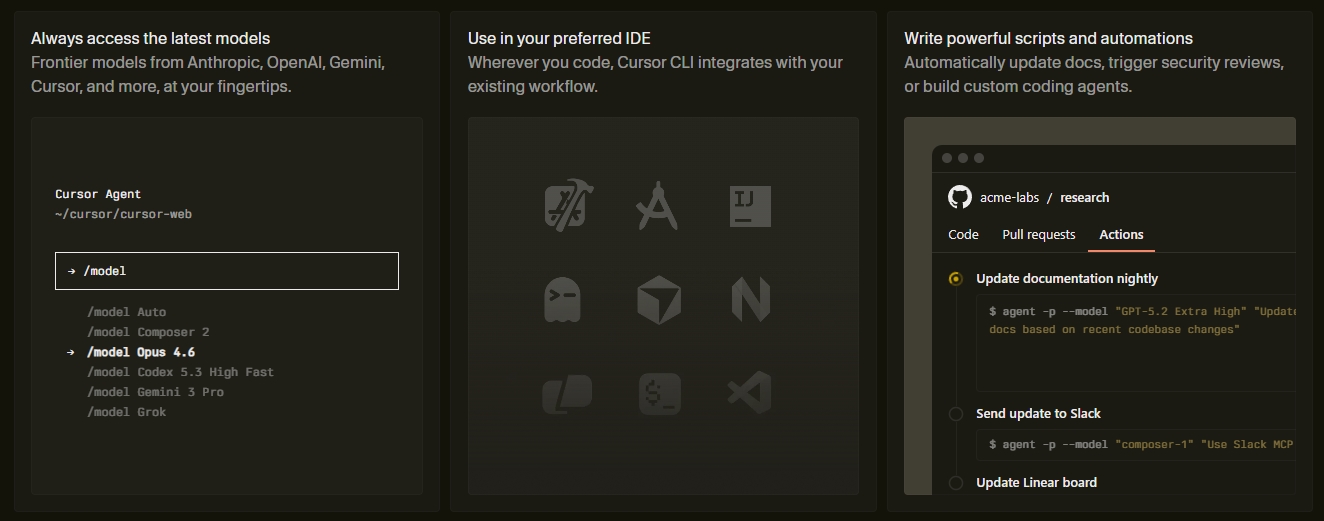
cursor help: Your ultimate guide. This command displays a comprehensive list of all available commands and their descriptions. It’s your first stop for exploring capabilities.cursor ask "How do I create a Python virtual environment?": Pose direct questions to the AI. Get instant, context-aware answers or code snippets directly in your terminal.cursor complete "def factorial(n):": Let the AI fill in the blanks. Provide a starting point, and Cursor CLI intelligently completes the code for you.cursor edit: Open a file for AI-assisted editing. The AI can suggest changes, refactor, or explain code within that file.
These commands offer a powerful introduction to the efficiency gains awaiting you with Cursor CLI. Start experimenting and feel the difference!
Advanced AI Features of the Cursor CLI
Beyond basic command execution, the Cursor CLI offers a suite of advanced AI features that elevate it far beyond a typical terminal tool. These capabilities transform your command line interface into a truly intelligent partner for complex developer utilities and sophisticated scripting.
Explore these cutting-edge functionalities:
- Contextual Code Analysis: The AI understands your entire project’s context, not just the current file. It analyzes dependencies, existing functions, and project structure for highly relevant suggestions and generations.
- Multi-Turn Conversations: Engage in an ongoing dialogue with the AI. Refine requests, ask follow-up questions, and iteratively develop solutions without losing context from previous interactions.
- Proactive Suggestion Engine: As you type, the Cursor CLI offers proactive code suggestions, refactoring ideas, and potential bug fixes, anticipating your needs before you fully express them.
- Code Transformation & Refactoring: Command the AI to refactor entire code blocks, convert language constructs, or optimize algorithms, dramatically speeding up code improvements.
- Complex Problem Solving: Present intricate technical challenges or abstract problems. The AI can break them down, suggest architectural patterns, and even generate proof-of-concept solutions.
These advanced features cement Cursor CLI‘s position as a revolutionary force in developer utilities, pushing the boundaries of what a terminal tool can accomplish.
Generating Code with Cursor CLI: A Deep Dive
Generating code efficiently is a cornerstone of modern development, and Cursor CLI excels in this area. It transforms abstract ideas or specific requirements into working code directly within your command line interface. This isn’t just about simple snippets; it’s about crafting substantial blocks of functional code tailored to your needs.
Here’s how you can leverage Cursor CLI for superior code generation:
- Describe Your Intent: Clearly articulate what you want the code to do. For example: “Generate a Python function to read a CSV file into a Pandas DataFrame, handling missing values.”
- Specify Constraints: Add details about language, libraries, or specific patterns. “Use `numpy` for array operations and `sklearn` for a linear regression model.”
- Iterate and Refine: If the initial output isn’t perfect, provide feedback. “Make that function asynchronous,” or “Add type hints to the parameters.”
- Generate Tests: After code generation, ask Cursor CLI to generate unit tests for the newly created function, ensuring robustness and correctness from the start.
This powerful scripting capability significantly reduces boilerplate writing and accelerates the initial phases of project development. The Cursor CLI becomes an indispensable terminal tool for any developer looking to expedite their developer utilities.
Efficient Debugging and Error Fixing Using Cursor CLI
Debugging consumes a significant portion of a developer’s time. Cursor CLI redefines this often-frustrating process, turning it into an efficient, AI-assisted experience right in your command line interface. It’s more than just finding errors; it’s about understanding and resolving them rapidly.
Here’s how Cursor CLI transforms debugging:
- Instant Error Analysis: When an error occurs, simply paste the traceback or output into Cursor CLI. The AI immediately analyzes the context and provides a clear explanation of the root cause.
- Suggested Fixes: Beyond identification, it offers concrete, actionable solutions. These might include code changes, dependency updates, or configuration adjustments.
- Contextual Repair: Point Cursor CLI to a problematic code section. It suggests specific code modifications to resolve the issue, often generating the corrected lines directly for you.
- “Explain Code” Feature: If a piece of code is behaving unexpectedly, ask the AI to explain its logic. This often uncovers misunderstandings or subtle bugs.
- Interactive Troubleshooting: Engage in a dialogue with the AI, asking “Why did this happen?” or “What are other potential causes?” to deepen your understanding and ensure a robust fix.
With Cursor CLI, debugging becomes a collaborative effort. This intelligent terminal tool dramatically cuts down the time spent on error fixing, enhancing your overall developer utilities.
Customizing Your Cursor CLI Experience
Your workflow is unique, and the Cursor CLI respects that. Personalization is key to maximizing your productivity with this powerful command line interface. Tailor your terminal tool to fit your preferences, ensuring a truly bespoke and efficient developer utilities experience.
Explore these customization options:
- Prompt Engineering: Develop custom AI prompts for frequently performed tasks. Create reusable templates that guide the AI to generate specific types of code or responses.
- Output Formatting: Configure how Cursor CLI presents its AI-generated output. Choose between raw code, markdown, or specific syntax highlighting to match your needs.
- Alias Creation: Assign short, memorable aliases to complex Cursor CLI commands or frequently used AI queries. Streamline your input and speed up interactions.
- Theme and UI Adjustments: While a terminal tool has limited UI, adjust aspects like color schemes or font preferences within your terminal emulator to make Cursor CLI outputs more readable.
- Contextual Presets: Define project-specific settings or AI personas. For instance, set a preset for “frontend development” that biases AI suggestions towards JavaScript frameworks.
Make Cursor CLI truly yours. A personalized terminal tool is a powerful terminal tool.
Integrating Cursor CLI with Your Existing Development Environment
The true power of Cursor CLI shines when it seamlessly integrates into your existing development environment. This isn’t about replacing your favorite tools; it’s about enhancing them, transforming your command line interface into a smarter, more productive hub for all your developer utilities.
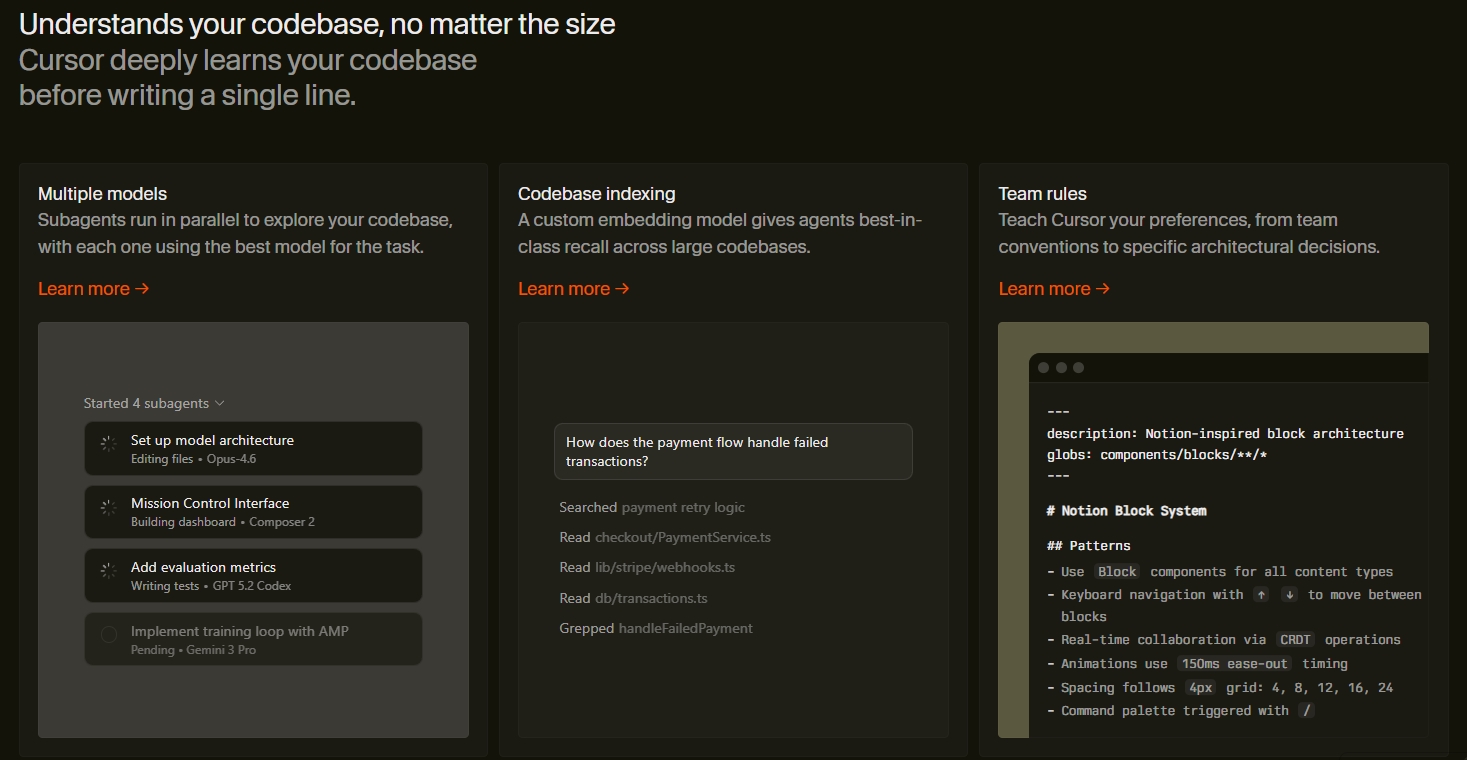
- IDE & Editor Complements: While Cursor CLI operates in the terminal, its AI output can be easily piped into your IDE or text editor. Use `cursor generate | pbcopy` (macOS) to quickly move generated code.
- Version Control Systems (VCS): Leverage Cursor CLI to generate commit messages, review changes, or even suggest refactors before committing. Integrate it into pre-commit hooks for AI-driven code quality checks.
- Build Tools & Task Runners: Use the AI to generate or debug build scripts (e.g., Makefiles, npm scripts). Ask Cursor CLI to explain compiler errors or suggest optimization flags for your existing tooling.
- Scripting Workflows: Embed Cursor CLI commands directly into your shell scripts. Automate complex developer utilities by having AI dynamically generate parts of your script based on runtime conditions.
- Cloud & DevOps Tools: Generate infrastructure-as-code snippets (Terraform, CloudFormation) or troubleshoot deployment issues by asking Cursor CLI about error logs from your cloud environment.
By making Cursor CLI an integral part of your ecosystem, you create a harmonious, AI-augmented workflow that elevates every aspect of your development process, making it the smartest terminal tool in your arsenal.
Practical Use Cases for Cursor CLI in Daily Development
The Cursor CLI isn’t just a theoretical marvel; it’s a practical, everyday terminal tool that solves real problems in your daily development. Integrating this AI-powered command line interface transforms common developer utilities into efficient, automated tasks.
Here are compelling scenarios where Cursor CLI shines:
- Boilerplate Generation:
- Need a new component in React, a controller in Node.js, or a class in Python? Describe it, and Cursor CLI scaffolds the basic structure instantly, saving you typing and setup time.
- Complex Regex Construction:
- Struggling with a tricky regular expression? Tell Cursor CLI what pattern you need to match, and it generates the correct regex. No more trial and error!
- Shell Scripting Assistance:
- Forget obscure `awk` or `sed` commands. Explain your data transformation or file manipulation task in plain language, and the Cursor CLI writes the shell script for you.
- API Endpoint Creation:
- Define your desired API functionality (e.g., “GET `/users` endpoint that returns a list of users from a database”), and Cursor CLI generates the routing and basic handler logic.
- Database Query Formulation:
- Crafting complex SQL or NoSQL queries can be tedious. Ask Cursor CLI to “write a query to find all active users who haven’t logged in in the last 30 days,” and get instant results.
These examples highlight how Cursor CLI empowers you to accomplish more with less effort, making it an indispensable asset for any developer engaged in serious scripting.
Boosting Performance: How Cursor CLI Optimizes Your Workflow
Optimizing your workflow is crucial for maximizing output, and the Cursor CLI acts as a powerful catalyst for performance gains. This AI-driven terminal tool doesn’t just add features; it fundamentally streamlines how you interact with your code, elevating your developer utilities to new heights.
Discover how Cursor CLI fine-tunes your efficiency:
- Reduced Cognitive Load: By handling repetitive coding patterns, syntax recalls, and debugging analysis, the AI frees your mind to focus on higher-level problem-solving and architectural design.
- Accelerated Information Retrieval: Instantly get answers, documentation, or code examples directly in your command line interface, eliminating the need to search external resources or switch browser tabs.
- Minimized Context Switching: Complete a wide array of tasks—from code generation to error fixing—without ever leaving your terminal, maintaining focus and flow.
- Automated Repetitive Tasks: Turn manual, time-consuming scripting into single AI prompts. This automates common developer utilities, saving hours over a project lifecycle.
- Proactive Issue Resolution: The AI’s ability to suggest fixes or optimize code before execution prevents issues, reducing costly rework and debugging cycles.
By handling repetitive coding patterns, syntax recalls, and debugging analysis, the AI frees your mind to focus on higher-level problem-solving and architectural design.
Cursor CLI is more than just an intelligent assistant; it’s a performance multiplier, ensuring your terminal tool helps you deliver faster, cleaner code with less effort.
Security Best Practices for AI-Powered CLI Tools
Leveraging AI in your command line interface, especially with tools like Cursor CLI, introduces powerful capabilities, but also demands a mindful approach to security. As with any advanced developer utilities, protecting your code and data is paramount. Implement these best practices to ensure a secure and productive experience with your AI-powered terminal tool.
- Limit Sensitive Data Exposure:
- Avoid pasting highly sensitive or proprietary code snippets, API keys, or personal identifiable information directly into AI prompts, especially if the tool relies on external models.
- Review AI-Generated Code:
- Always treat AI-generated code as a suggestion. Thoroughly review and understand it before committing it to your codebase. Check for potential vulnerabilities, incorrect logic, or unintended side effects.
- Understand Data Handling:
- Familiarize yourself with the privacy policy and data retention practices of Cursor CLI. Know how your interactions and code snippets are used, stored, and protected.
- Keep Your Tool Updated:
- Regularly update your Cursor CLI installation. Updates often include security patches, performance improvements, and model enhancements that protect against new threats.
- Use Secure Credentials:
- If Cursor CLI requires authentication, use strong, unique passwords and enable multi-factor authentication (MFA) where available to secure your access.
Always treat AI-generated code as a suggestion. Thoroughly review and understand it before committing it to your codebase. Check for potential vulnerabilities, incorrect logic, or unintended side effects.
By adhering to these principles, you can safely harness the immense power of Cursor CLI as an advanced terminal tool, confident in your data and code integrity.
Cursor CLI vs. Traditional CLI: A Comparative Analysis
Understanding the distinction between Cursor CLI and traditional command line interface tools highlights the revolutionary leap in developer utilities. While traditional CLIs are fundamental, Cursor CLI elevates the terminal tool experience with intelligent, proactive capabilities.
| Feature | Traditional CLI | Cursor CLI (AI-Powered) |
|---|---|---|
| Interaction Model | Explicit commands, syntax-driven, reactive. | Conversational, intent-driven, proactive suggestions. |
| Code Generation | None; relies on manual typing or snippets. | Generates functions, classes, and complex logic based on natural language. |
| Debugging Assistance | Manual interpretation of error messages, trial-and-error. | Analyzes errors, explains causes, suggests specific fixes automatically. |
| Context Awareness | Limited to current command or file. | Understands entire project context, dependencies, and previous interactions. |
| Learning & Adaptation | Static; requires user to learn and adapt. | Learns from interactions, improves suggestions, adapts to user style. |
| Productivity Gain | Achieved through mastery of individual commands. | Exponential increase through automation, smart assistance, and reduced cognitive load. |
Cursor CLI marks a paradigm shift. It transforms the often-rigid command line interface into a flexible, intelligent partner, making your scripting and coding significantly more efficient. It is truly a next-generation terminal tool for developer utilities.
Troubleshooting and FAQs for Cursor CLI Users
Even the most advanced terminal tool can encounter hiccups. This section addresses common issues and frequently asked questions for Cursor CLI users, ensuring a smooth and productive experience with your AI-powered command line interface. Leverage these insights for quick problem-solving and enhanced developer utilities.
Common Troubleshooting Tips:
- “Cursor command not found”: Verify your installation path is in your system’s PATH variable. Re-run the installation or consult the setup instructions.
- AI responses are slow/irrelevant: Check your internet connection. Ensure you have the latest version of Cursor CLI, as model updates improve performance. Try rephrasing your prompt for clarity.
- Authentication issues: Re-authenticate using `cursor login` or similar command. Check your API key or token if you are using a self-hosted or custom setup.
- Output formatting issues: Sometimes, terminal configurations can affect display. Try a different terminal emulator or adjust its settings. You can also ask Cursor CLI to output in a specific format (e.g., Markdown).
Frequently Asked Questions:
Q: Does Cursor CLI send my code to external servers?
A: It depends on the specific configuration and model used. Always review the privacy policy and settings to understand how your data is handled. Many setups prioritize local processing or secure encrypted communication.
Q: Can I use Cursor CLI offline?
A: Core functionalities might be limited without an internet connection, as AI models typically require cloud access. Some local caching or smaller models might offer partial offline capabilities.
Q: Is there a cost associated with Cursor CLI?
A: Availability and pricing models vary. Check the official Cursor CLI website for current plans, which may include free tiers, subscription options, or enterprise solutions.
If these don’t resolve your issue, consult the official Cursor CLI documentation or community forums for further assistance. Your intelligent terminal tool is designed to make your scripting easier, and we’re here to help.
The Evolution of Command Line Interfaces with Cursor CLI
The command line interface has long been the bedrock of developer utilities, a powerful, albeit often cryptic, terminal tool. With the advent of Cursor CLI, we’re not just witnessing an incremental update; we are experiencing a profound evolution. This AI-powered tool fundamentally reshapes how we interact with our systems, pushing the boundaries of what a CLI can achieve.
Historically, CLIs demanded precise syntax and a deep memory of commands. They were reactive tools, executing exactly what you told them, no more, no less. Cursor CLI, however, brings intelligence and proactivity to the forefront. It understands intent, fills in gaps, and even suggests paths you hadn’t considered, making complex scripting accessible and intuitive.
This shift from purely declarative commands to conversational interaction marks a new era. Developers no longer need to memorize every flag or argument. Instead, they can express their goals in natural language, relying on Cursor CLI to translate those intentions into executable code and actions. This intelligence accelerates development, reduces errors, and democratizes access to powerful developer utilities.
The future of the terminal is intelligent, adaptive, and collaborative. Cursor CLI stands at the vanguard of this evolution, proving that your most trusted terminal tool can also be your smartest partner in every coding endeavor.
Frequently Asked Questions
What is the Cursor CLI?
The Cursor CLI is an intelligent command line interface that integrates sophisticated artificial intelligence directly into your terminal environment. It acts as an AI-powered coding assistant, ready to interpret your intentions and execute complex tasks like code generation, debugging, and contextual suggestions.
How does Cursor CLI boost developer productivity?
Cursor CLI significantly enhances productivity through features such as rapid code generation, contextual awareness of your entire project, proactive error prevention, reduced context switching by keeping you in the terminal, and automated scripting based on natural language prompts, allowing you to focus on innovation.
What are the basic system requirements for installing Cursor CLI?
Cursor CLI is compatible with major operating systems like macOS, Linux, and Windows Subsystem for Linux (WSL). It recommends at least 8GB of RAM, 500MB of free disk space, a stable internet connection for AI model access and updates, and a recent version of Python (3.8+) for optimal performance.
Can Cursor CLI assist with debugging and error fixing?
Yes, Cursor CLI transforms debugging into an efficient, AI-assisted experience. It provides instant error analysis, suggests concrete and actionable fixes, performs contextual code repair, explains complex code logic, and supports interactive troubleshooting to help you understand and resolve issues rapidly.
What security best practices should I follow when using AI-powered CLI tools like Cursor CLI?
When using AI-powered CLI tools, it’s crucial to limit sensitive data exposure in prompts, thoroughly review all AI-generated code for potential vulnerabilities, understand the tool’s privacy policy and data handling practices, regularly update your installation for security patches, and use strong, multi-factor authenticated credentials for access.