


Unlock peak productivity and streamline your coding process. Mastering your Cursor Tab settings transforms how you interact with code, significantly boosting your efficiency. Imagine navigating complex files with precision, always placing your cursor exactly where you need it, instantly. This isn’t just about indentation; it’s about advanced text navigation, empowering you with unparalleled control over your workspace. Dive in and discover how a well-configured code editor tab system can redefine your daily coding experience.
Your workflow deserves every advantage. Let’s optimize it.
- Understanding the Cursor Tab Concept
- What Exactly is a Cursor Tab?
- Differentiating Cursor Movement from Indentation
- Configuring Cursor Tab Behavior in Popular IDEs
- Setting Cursor Tab Preferences in VS Code
- Customizing Cursor Tab in Sublime Text
- Managing Cursor Tab in IntelliJ IDEA and Other Editors
- Keyboard Shortcuts for Efficient Cursor Tab Use
- Cursor Tab vs. Spaces: The Indentation Dilemma
- Best Practices for Code Consistency
- Benefits of Customizing Your Cursor Tab Settings
- Enhancing Code Readability and Maintenance with Consistent Tabs
- Accessibility and Keyboard Navigation with Cursor Tab
- Troubleshooting Common Cursor Tab Problems
- Advanced Cursor Tab Techniques for Developers
- Essential Plugins and Extensions for Enhanced Tab Control
- Establishing Team Standards for Cursor Tabs
- The Evolution of Tab Navigation in Software
- Cursor Tab in Web Browsers and Form Fields
- Optimizing Productivity with Smart Cursor Tab Use
- Future Trends in Text Editing and Cursor Tab Functionality
- Frequently Asked Questions
Understanding the Cursor Tab Concept
The Cursor Tab is more than a simple keystroke; it’s a fundamental mechanism for structural navigation within any text editor or Integrated Development Environment (IDE). It dictates how your cursor moves through text, especially in relation to indentation levels and defined stops. Understanding this concept is crucial for efficient tab management and smooth interaction with your code. It influences how you traverse lines, blocks, and even logical sections of your work.
“A well-understood Cursor Tab concept is the bedrock of fluid workspace navigation.”
This underlying principle ensures predictable and precise cursor placement, making repetitive tasks far less cumbersome. It’s about clarity and control in every keystroke.
What Exactly is a Cursor Tab?
At its core, a Cursor Tab refers to the action of the cursor moving a predefined horizontal distance when you press the Tab key. This distance typically aligns with indentation levels, but it’s distinct from merely inserting a tab character or a set number of spaces. Instead, it’s an intelligent navigation action, often skipping over structural elements or aligning with predefined stops within your editor. Think of it as a smart jump for your cursor, designed to respect your code’s structure and your editor’s IDE features.
It helps you:
- Quickly jump to the next logical position.
- Align text columns efficiently.
- Maintain visual consistency across your codebase.
Differentiating Cursor Movement from Indentation
While often intertwined, cursor movement via the Tab key and code indentation serve distinct purposes. Indentation involves inserting characters (spaces or tabs) to define the hierarchical structure of your code. Cursor tab movement, however, focuses on *navigating* your cursor across the text, often using those existing indentation levels as guides. You might press Tab to move past a block of code, not necessarily to insert new indentation. It’s about leveraging existing structure for efficient workspace navigation rather than creating new structure. One creates; the other traverses.
Configuring Cursor Tab Behavior in Popular IDEs
Tailoring your Cursor Tab behavior is a powerful step towards a personalized and highly efficient coding environment. Every major IDE offers extensive options to define how the Tab key functions for both indentation and cursor navigation. Proper configuration ensures your editor aligns perfectly with your coding style and team standards, dramatically improving your tab management. Don’t settle for default settings; make your code editor tab work for you.
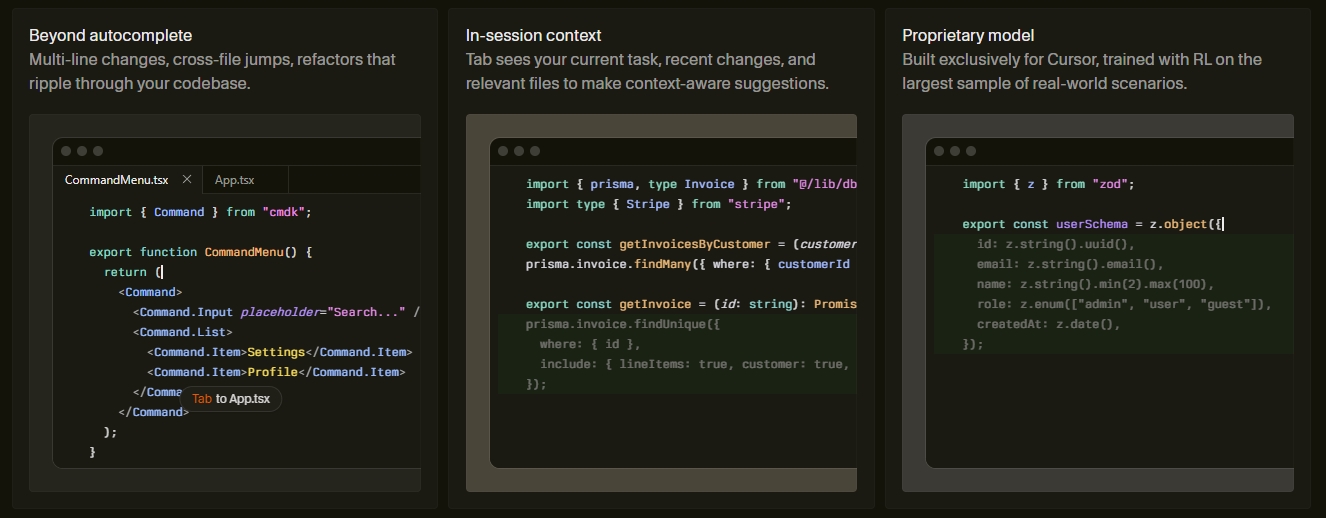
Setting Cursor Tab Preferences in VS Code
Visual Studio Code provides robust controls for your Cursor Tab preferences. Access these through the Settings (Ctrl+, or Cmd+,). Here, you can define:
- Tab Size: Set the number of spaces a tab character represents.
- Insert Spaces: Decide whether pressing Tab inserts spaces or actual tab characters.
- Detect Indentation: VS Code can intelligently guess your project’s indentation rules.
- Editor: Tab Size: A dedicated setting specifically for the visual width of a tab.
These settings are crucial for maintaining consistent code style across your projects and enhancing your overall IDE features experience.
Customizing Cursor Tab in Sublime Text
Sublime Text offers powerful customization for your Cursor Tab through its preference files. You can modify user-specific or syntax-specific settings to fine-tune tab behavior. Open Preferences > Settings and locate:
"tab_size": N: Determines the width of a tab."translate_tabs_to_spaces": true/false: Converts tab characters to spaces."auto_indent": true/false: Automatically indents new lines.
By customizing these values, you gain granular control, ensuring your tab management aligns with your exact coding habits.
Managing Cursor Tab in IntelliJ IDEA and Other Editors
IntelliJ IDEA, along with other JetBrains IDEs, provides a comprehensive suite of options for managing Cursor Tab behavior. Navigate to File > Settings > Editor > Code Style. Here you can configure:
- Tab size: Define the visual width.
- Indent size: Specify the indentation step.
- Use tab character: Choose between tabs or spaces for indentation.
- Smart tabs: Enables intelligent indentation based on context.
Similar settings exist in other powerful editors, ensuring a consistent workspace navigation experience regardless of your chosen platform. Explore your editor’s settings to discover its full range of IDE features for tab control.
Keyboard Shortcuts for Efficient Cursor Tab Use
Mastering keyboard shortcuts is paramount for truly efficient Cursor Tab use. These shortcuts transform tedious manual navigation into fluid, instantaneous actions, significantly speeding up your coding process. Rather than clicking or laboriously arrow-keying, leverage these powerful commands for rapid workspace navigation.
Common essential shortcuts include:
| Action | Windows/Linux | macOS | Benefit |
|---|---|---|---|
| Indent/Tab Selected Lines | Tab | Tab | Shift multiple lines right. |
| Unindent/Shift Tab Selected Lines | Shift + Tab | Shift + Tab | Shift multiple lines left. |
| Move Cursor to Next Indent Level | Tab (in specific contexts) | Tab (in specific contexts) | Fast horizontal navigation. |
| Select to Next Indent Level | Shift + Tab (in specific contexts) | Shift + Tab (in specific contexts) | Quickly select blocks of code. |
Integrate these into your daily routine. You will feel the difference in your coding speed and precision, making tab management an intuitive part of your muscle memory.
Cursor Tab vs. Spaces: The Indentation Dilemma
The “tabs versus spaces” debate is legendary in the coding world, extending directly to how your Cursor Tab functions. This choice dictates not just the visual appearance of your code but also impacts file size, cross-platform consistency, and even merge conflicts. Whether you prefer the single tab character or a series of spaces for your code editor tab, this decision profoundly influences the readability and maintainability of your projects. Each approach has its champions and valid arguments.
Ultimately, consistency within a project or team matters far more than the specific choice itself. Define your preference and stick to it rigorously to avoid an “indentation dilemma” that can plague collaboration.
Consider these points when making your choice:
- Tab Characters: Users can set their preferred tab width, offering personalization.
- Spaces: Provide absolute pixel-perfect consistency across all editors and viewers, preventing alignment issues.
Ultimately, consistency within a project or team matters far more than the specific choice itself. Define your preference and stick to it rigorously to avoid an “indentation dilemma” that can plague collaboration.
Best Practices for Code Consistency
Achieving absolute code consistency, especially regarding indentation, is a non-negotiable best practice. It streamlines collaboration, enhances readability, and reduces mental overhead for every developer touching the codebase. Your approach to tab management directly feeds into this. Establish clear rules and enforce them to ensure a unified style throughout your projects.
Key strategies for consistency:
- Team Agreement: Decide on tabs or spaces, and the tab width, as a team.
- EditorConfig: Use an
.editorconfigfile to define indentation rules that all IDEs can read and respect. - Linters & Formatters: Integrate tools like ESLint, Prettier, or Black to automatically format code and flag inconsistencies.
- Pre-commit Hooks: Automate formatting checks before code is committed to prevent style deviations from entering the repository.
By implementing these practices, you transform individual IDE features into a cohesive, team-wide standard, benefiting everyone.
Benefits of Customizing Your Cursor Tab Settings
Customizing your Cursor Tab settings offers a multitude of benefits that extend far beyond mere aesthetics. It’s a strategic move to optimize your personal coding environment, leading to tangible improvements in comfort, speed, and accuracy.
Customizing your Cursor Tab settings offers a multitude of benefits that extend far beyond mere aesthetics. It’s a strategic move to optimize your personal coding environment, leading to tangible improvements in comfort, speed, and accuracy. When your editor’s tab behavior perfectly matches your mental model of code structure, you experience a seamless flow that reduces friction and enhances focus.
Consider these key advantages:
- Reduced Eye Strain: Visually align code to your preference, making it easier to parse.
- Faster Navigation: Cursor jumps precisely, minimizing manual adjustments.
- Fewer Errors: Consistent indentation prevents subtle bugs caused by misaligned code blocks.
- Personalized Workflow: Tailor the editor to your unique coding style and habits.
- Enhanced Focus: Spend less time fighting your editor and more time solving problems.
Invest a few moments in configuration. The return on investment in terms of sustained productivity and coding satisfaction is immense. Make your code editor tab work for you.
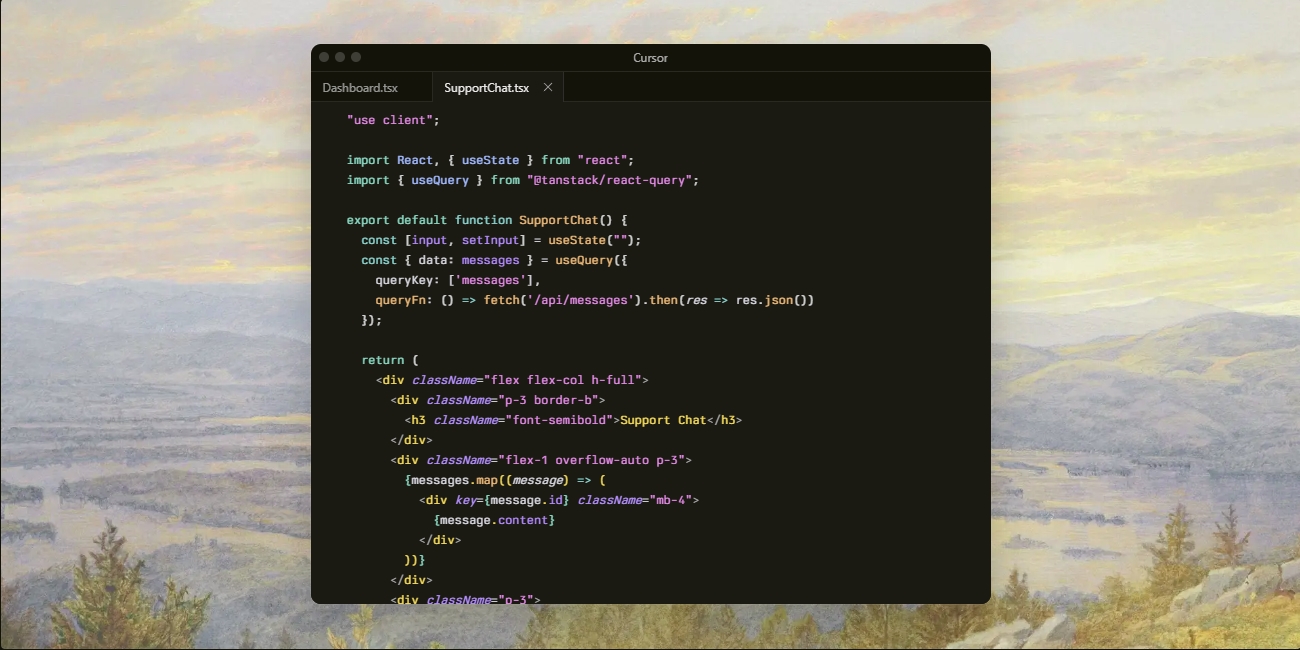
Enhancing Code Readability and Maintenance with Consistent Tabs
The impact of consistent tabs on code readability and maintenance cannot be overstated. A uniform approach to your code editor tab settings transforms dense code into a visually structured, easily digestible format.
The impact of consistent tabs on code readability and maintenance cannot be overstated. A uniform approach to your code editor tab settings transforms dense code into a visually structured, easily digestible format. When every block, function, and statement aligns predictably, developers spend less time deciphering layout and more time understanding logic. This clarity is a direct result of meticulous tab management.
Consistent indentation:
- Visually Delineates Blocks: Quickly identify scopes and control flow.
- Reduces Cognitive Load: Brains process consistent patterns faster.
- Simplifies Debugging: Misaligned code often hides bugs; consistency exposes them.
- Facilitates Collaboration: Team members instantly recognize the structure, reducing merge conflicts.
- Improves Onboarding: New team members grasp the codebase quicker with a clear, uniform style.
Ultimately, a codebase with consistent tabs is a codebase that is a joy to read, easy to modify, and cheaper to maintain over its lifetime. It’s an investment in the longevity and quality of your software.
Accessibility and Keyboard Navigation with Cursor Tab
Effective Cursor Tab configurations play a crucial role in enhancing both accessibility and keyboard navigation. For users who rely primarily on keyboard input, a well-defined tab behavior is indispensable. It provides a predictable and efficient way to move through code, interact with UI elements, and manage editor panels without needing a mouse. Thoughtful workspace navigation through intelligent tab stops makes the development environment more inclusive and productive for everyone.
Consider how smart tab use supports:
- Screen Reader Users: Consistent indentation allows screen readers to convey code structure accurately.
- Motor Impairments: Reducing reliance on fine motor control for mouse movements.
- Power Users: Keyboard-only navigation is often faster for experienced developers.
- Focus Management: The tab key is the standard for moving focus between interactive elements in applications.
By ensuring your code editor tab settings are logical and consistent, you create a more accessible and efficient environment for all developers, broadening the reach and usability of your tools.
Troubleshooting Common Cursor Tab Problems
Even with careful configuration, Cursor Tab problems can occasionally arise, disrupting your flow and causing frustration. Recognizing and quickly resolving these common issues is key to maintaining a smooth development experience and effective tab management. Don’t let unexpected tab behavior slow you down; equip yourself with the knowledge to troubleshoot effectively.

Frequent issues and their solutions:
| Problem | Cause | Solution |
|---|---|---|
| Mixed Tabs and Spaces | Inconsistent editor settings or team standards. | Configure .editorconfig, use a linter, or run a formatter. |
| Unexpected Cursor Jumps | Smart indent features misinterpreting context. | Review IDE’s “smart tab” or “auto-indent” settings for specific languages. |
| Tab Key Inserts Spaces Instead of Tabs | “Translate tabs to spaces” enabled. | Disable this setting in your editor preferences. |
| Inconsistent Tab Width | Different settings between editor and project. | Ensure editor’s tab size matches project’s .editorconfig or style guide. |
Always check project-level settings (like .editorconfig) first, as they often override user-level preferences. A quick check of your IDE features and project configurations usually pinpoints the culprit.
Advanced Cursor Tab Techniques for Developers
Beyond basic indentation, advanced Cursor Tab techniques unlock new levels of precision and speed for experienced developers. These aren’t just about moving the cursor; they involve leveraging your editor’s intelligence to perform complex text manipulations with a single keystroke. Integrating these into your routine can drastically reduce repetition and elevate your code editor tab mastery.
Explore these sophisticated approaches:
- Block Selection with Tab: Use
Shift + Tabto select entire blocks of code, then re-indent or manipulate them. - Multi-Cursor Tab Manipulation: With multiple cursors active, pressing Tab indents all selected lines simultaneously, a powerful feature for batch editing.
- Context-Aware Tab Stops: Many modern IDEs allow defining custom tab stops or “soft tabs” that align to specific syntax elements, not just fixed distances.
- Smart Indent Beyond Line Start: Configure your Tab key to jump to the next logical alignment point within a line, not just the beginning of the next indentation level.
- Tab to Next Error/Warning: Some extensions allow Tab to jump your cursor to the next highlighted issue, streamlining debugging.
Mastering these IDE features transforms the Tab key from a simple spacer into a dynamic tool for rapid code transformation and workspace navigation.
Essential Plugins and Extensions for Enhanced Tab Control
To truly master Cursor Tab behavior and elevate your tab management, explore the vast ecosystem of plugins and extensions available for your preferred editor. These powerful additions can significantly enhance, automate, and refine how your code editor tab operates, pushing beyond default IDE features. They provide specialized functionalities that cater to specific workflows or enforce stricter code styles.
Look for plugins that offer:
- Indent Guides: Visual lines indicating indentation levels, making code structure clearer.
- Whitespace Linters: Automatically detect and highlight inconsistent tabs, spaces, or trailing whitespace.
- Advanced Tab Switchers: Enhance editor’s ability to navigate between open tabs (files) quickly.
- Code Formatters: Automatically reformat entire files or selections according to predefined style guides, ensuring consistent indentation.
- Tab-aware Navigation: Plugins that modify arrow key behavior to respect tab stops, moving the cursor by logical indentation blocks.
Installing the right extensions empowers you with unparalleled control and automation, making your editor an even more intelligent partner in your development process.
Establishing Team Standards for Cursor Tabs
For any collaborative coding environment, establishing team standards for Cursor Tabs is not optional; it’s fundamental. Inconsistent tab management across a team leads to frustrating merge conflicts, endless arguments over style, and a significant drain on productivity. A unified approach ensures everyone on the team adheres to the same code editor tab conventions, fostering a harmonious and efficient development workflow.
Steps to create effective team standards:
- Discuss & Decide: Hold a team discussion to agree on a single style: tabs or spaces, and the specific tab width.
- Document Clearly: Write down your agreed-upon standards in a visible location (e.g., project README, wiki).
- Implement
.editorconfig: Create an.editorconfigfile at the root of your project to automatically enforce tab settings across various IDEs. - Integrate Linters & Formatters: Use automated tools configured to your standards (e.g., ESLint, Prettier) to fix or flag deviations.
- Educate New Members: Ensure new developers are aware of and understand the team’s tab conventions from day one.
A consistent codebase is a clean codebase, reducing friction and allowing the team to focus on building features, not fighting indentation.
The Evolution of Tab Navigation in Software
The concept of tab navigation in software has undergone a fascinating evolution, from simple mechanical actions to highly intelligent, context-aware movements. What began as a means to quickly move between fixed positions on a typewriter has transformed into a sophisticated mechanism for structural workspace navigation within modern code editors and applications. This journey highlights the continuous drive for efficiency and user-centric design in digital interfaces.
A brief look at this evolution:
- Early Text Editors: Tab key primarily inserted a literal tab character, often leading to inconsistent display across different systems.
- Word Processors: Introduced the concept of user-definable tab stops for precise text alignment.
- Programming Editors: Began to differentiate between actual tab characters and “soft tabs” (spaces), along with auto-indentation based on syntax.
- Modern IDEs (like VS Code, IntelliJ IDEA): Integrated “smart tabs” that anticipate code structure, multi-cursor tab manipulation, and deeply customizable IDE features for navigation.
- Web Browsers: Tab key became essential for navigating interactive elements (links, form fields), crucial for accessibility.
This ongoing evolution demonstrates how a seemingly simple key press continues to adapt and grow, offering increasingly powerful ways to interact with digital content.
Cursor Tab in Web Browsers and Form Fields
The utility of the Cursor Tab extends far beyond code editors, playing a critical role in web browsers and form fields. Here, the Tab key primarily serves as a powerful accessibility and efficiency tool for navigating interactive elements. Understanding its function in this context is essential for web developers building user-friendly and accessible websites. It enables seamless workspace navigation for users who prefer or require keyboard-only interaction.
How Tab functions in browsers:
- Focus Management: Pressing Tab moves the keyboard focus sequentially through interactive elements like links, buttons, and input fields.
- Accessibility: Crucial for users with motor impairments or those relying on screen readers, providing a predictable way to interact with web content.
- Form Navigation: Speeds up data entry by allowing users to quickly jump between form fields without needing to reach for a mouse.
- Shift + Tab: Reverses the navigation order, moving focus to the previous interactive element.
Developers must ensure a logical tab order (tabindex attribute) on their web pages to provide an intuitive and efficient experience for all users. It’s a cornerstone of good user interface design.
Optimizing Productivity with Smart Cursor Tab Use
Truly optimizing productivity with smart Cursor Tab use involves more than just knowing how to indent. It’s about consciously configuring and leveraging your editor’s code editor tab capabilities to minimize keystrokes, reduce mental fatigue, and accelerate your coding workflow. When your tab behavior is intelligently tailored, repetitive tasks become second nature, freeing your mind to focus on complex problem-solving.
Strategies for smart tab use:
- Contextual Tab Behavior: Configure your editor to auto-indent based on the language and surrounding code, anticipating your next move.
- Quick Block Indentation: Master selecting multiple lines and using Tab/Shift+Tab for rapid block-level adjustments.
- Integrated Formatters: Use tools that automatically reformat your code on save, ensuring perfect indentation without manual effort.
- Tab to Complete: Leverage IntelliSense or autocompletion features that often use Tab to insert suggestions, saving typing time.
- Custom Shortcuts: Bind editor commands related to tab stops or indentation to easy-to-reach keyboard shortcuts.
By making your Tab key an intelligent partner rather than just a simple indent button, you transform it into a powerful tool for unmatched coding efficiency and superior tab management.
Future Trends in Text Editing and Cursor Tab Functionality
The landscape of text editing is continuously evolving, and with it, the Cursor Tab functionality we rely on. Future trends point towards even more intelligent, context-aware, and personalized approaches to how our cursors navigate and interact with text. Expect exciting advancements that will redefine our relationship with the code editor tab, pushing the boundaries of what IDE features can achieve.
Anticipated developments include:
- AI-Assisted Tab Behavior: Machine learning algorithms might predict your next tab stop based on coding patterns and semantic context, not just indentation rules.
- Context-Aware Navigation: Tab key could intelligently jump to the next logical function argument, class member, or related definition.
- Dynamic Tab Stops: Editor adapts tab widths or alignment points dynamically based on screen size, font, or code complexity.
- Semantic Tab Selection: Selecting entire logical blocks (e.g., an “if” statement, a loop) with a single tab-related gesture.
- Enhanced Collaboration: Real-time co-editing environments will likely feature synchronized tab settings and more intelligent conflict resolution around indentation.
The future promises a text editing experience where your Cursor Tab is not just a tool for navigation, but an intelligent assistant, deeply integrated into your thought process.
Frequently Asked Questions
What is a Cursor Tab and how does it differ from indentation?
A Cursor Tab refers to the cursor moving a predefined horizontal distance when the Tab key is pressed, often aligning with existing indentation levels. While intertwined, indentation involves inserting characters (spaces or tabs) to define the hierarchical structure of your code, whereas Cursor Tab movement focuses on *navigating* the cursor across existing text and structure, rather than creating new structure.
How can I configure Cursor Tab behavior in popular IDEs like VS Code or IntelliJ IDEA?
In VS Code, you can access Settings (Ctrl+, or Cmd+,) to define tab size, whether to insert spaces, and allow indentation detection. For IntelliJ IDEA and similar JetBrains IDEs, navigate to File > Settings > Editor > Code Style where you can configure tab size, indent size, the use of tab characters, and smart tab features.
Why is it important to customize Cursor Tab settings?
Customizing Cursor Tab settings is crucial for optimizing your personal coding environment. It leads to tangible improvements such as reduced eye strain, faster and more precise navigation, fewer errors due to consistent indentation, a personalized workflow tailored to your unique style, and enhanced focus on problem-solving by reducing friction with your editor.
What are some best practices for achieving code consistency regarding tabs and spaces within a team?
Key best practices include establishing a clear team agreement on whether to use tabs or spaces and the specific tab width, implementing an .editorconfig file at the project root, integrating automated linters and formatters (like ESLint or Prettier), and using pre-commit hooks to ensure all code adheres to the defined style before being committed.
How does Cursor Tab functionality contribute to accessibility in web browsers?
In web browsers, the Tab key is fundamental for accessibility and efficiency, allowing users to navigate interactive elements (like links, buttons, and form fields) sequentially using only the keyboard. This is especially vital for users with motor impairments or those relying on screen readers, providing a predictable and efficient way to interact with web content without needing a mouse.